Amenorrhea: the absence of your period.
And then amenorrhea is divided into 2 categories: primary and secondary.
We’re going to talk about secondary amenorrhea, which can be observed as: the absence of a period for 3 months in women who had previously had REGULAR cycles, or the absence of a period for 6 months in women who had already been experiencing IRREGULAR cycles.
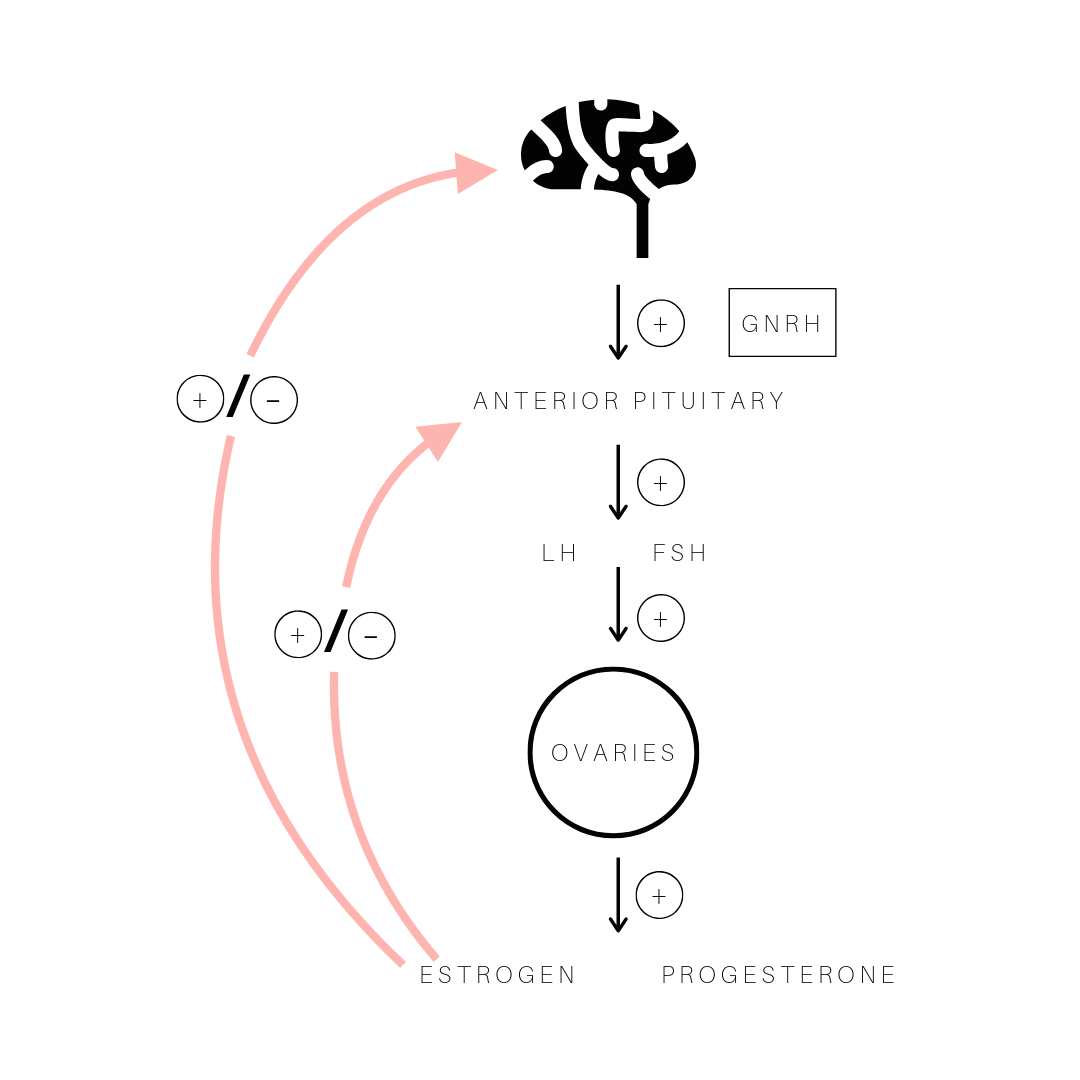
Functional hypothalamic amenorrhea (FHA) is the loss of a period caused by under-eating (or even not eating enough carbohydrates)/disordered eating, excessive exercise and/or stress. This leads to disruption of the hypothalamic-pituitary-ovarian (HPO) axis – yes, another axis! And women with normal, ‘healthy’ BMIs can also experience this – this does not simply apply to underweight women. This disruption can lead to estrogen deficiency – with potentially disastrous effects on mental health (women with FHA have shown greater susceptibility to anxiety and depression) (1), cardiovascular health, bone health and fertility. (2)
While FHA is considered a diagnosis of exclusion (your healthcare provider should work to rule out other causes, like PCOS, pregnancy, thyroid dysfunction, etc.), it’s important to consider in women who have lost their period in times of extreme mental or physical stress or during ketogenic, low-carb, or extremely restrictive dieting. Losing your period during a diet is not a good sign – period (literally)!
Low estrogen in premenopausal women is not normal and should always be addressed at the root cause.
Reference(s):
(1) PMID: 11476778
(2) PMID: 28658709
INTERESTED IN READING MORE?
Androgens are often referred to as ‘male sex hormones,’ but they’re present in both men and women. When it comes to women, we hear the most about testosterone, DHEA-S and DHT.
Birth control is NOT the only option for painful (dysmenorrhea) and/or heavy periods (menorrhagia). And before jumping on a medication or supplement your HCP should always look into potential causes of extreme cramping – ie. endometriosis, fibroids, etc.
Prostaglandins are a major factor in menstrual cramps – once a month (when Aunt Flow comes to town) they cause uterine muscles to contract in order to release the uterine lining (endometrium). Prostaglandins aren’t bad (they are important for blood clots, inducing labour, etc.), but if certain prostaglandins are high in your cycle – this can predispose to more painful menstrual cramping.
So - the liver is responsible for detoxing alcohol. But it’s also important for metabolizing estrogen. In women, more than one alcoholic drink per day has been shown to increase circulation of androgens (ie. testosterone) and estrogens (1, 2) – this predisposes you to symptoms of estrogen dominance.
I’m excited to share that in an effort to increase accessibility to naturopathic care, I am offering virtual consults to individuals who live in rural areas of Manitoba.
Perimenopause: the hormonal shift, occurring over months-years, which transitions you into menopause. ‘Peri’ means “around” or “near”, so - you get the point.
We’re stressed out, right? Well, the increased cortisol produced by stress makes us hungry - hungry for carbs, sugar and fat (and not the good kinds, okay?). If we follow suit and eat like this all the time we start to feel fatigued (and in desperately hoping for a caffeine boost), moody and may even start to find that we don’t think as clearly (some will call this ‘brain fog’). And stress forces our body to utilize a significant amount of nutrients to produce the energy we need to respond - even if our stress is created by sitting in front of a computer all day.
Chronically stressed out? I won’t lie, me too.
But yikes, that eventually catches up to you. Cortisol (aka our stress hormone) is important for our functioning (and our ability to adapt to stress) – but too much or too little can be problematic.
Do you know how to deal with chronically elevated cortisol?
Taking your biotin pretty consistently and still losing hair?
Well, there’s a ton of reasons why your hair might be thinning out. Let’s investigate.
I’m willing to bet you’ve heard the term ‘PCOS’ before.
Polycystic Ovarian Syndrome (PCOS). The first thing I want to emphasize: it’s a syndrome – not all signs and symptoms show up in every individual with PCOS.
So, how do you know if you have PCOS?